Beyond Christmas: Year-Round Uses for Permanent House Lights
Permanent LED track lights earn their keep all twelve months, not just in December. Here's how London-area homeowners use them for every holiday, game day, security, and everyday curb appeal.
Most people first hear about permanent LED lighting as a Christmas product, and it's easy to see why. A perfectly even roofline of holiday colour that switches on with your phone is a genuine upgrade over stapling up light strings in the cold. But if you only think of these lights as a December purchase, you're valuing them at a fraction of what they actually do. The lights are installed once and stay put, and the same track that glows red and green in winter becomes an everyday exterior lighting system the other eleven months of the year.
That distinction is the whole argument for permanent lighting over seasonal setups. A seasonal string gets used for maybe six weeks. A permanent system gets used most nights of the year. Below is an honest look at how homeowners across London and Southwestern Ontario actually use these lights once the tinsel comes down.
Every Holiday, Not Just Christmas
Because each LED point is individually addressable RGBW, you're not locked into one look. You pick colours and patterns from an app and the whole roofline updates in seconds. Over a calendar year that turns into a surprising number of occasions where the right colour just makes sense:
- Halloween: orange and purple, with slow flicker or chase effects that read well from the street.
- Valentine's Day: soft pinks and reds for a single evening without buying anything.
- St. Patrick's Day and Easter: greens, or pastels for spring.
- Canada Day and the July long weekend: red and white down the whole roofline, which tends to be the neighbourhood favourite.
- Remembrance Day, Diwali, Pride, and birthdays: whatever colour fits the moment.
- New Year's Eve: colour-cycling or a countdown scene at midnight.
None of this requires new product, ladders, or storage bins. You're reusing the same hardware you already paid for, which is exactly why the cost-per-use of a permanent system keeps dropping the longer you own it.
Warm-White Everyday Lighting (The Setting You'll Use Most)
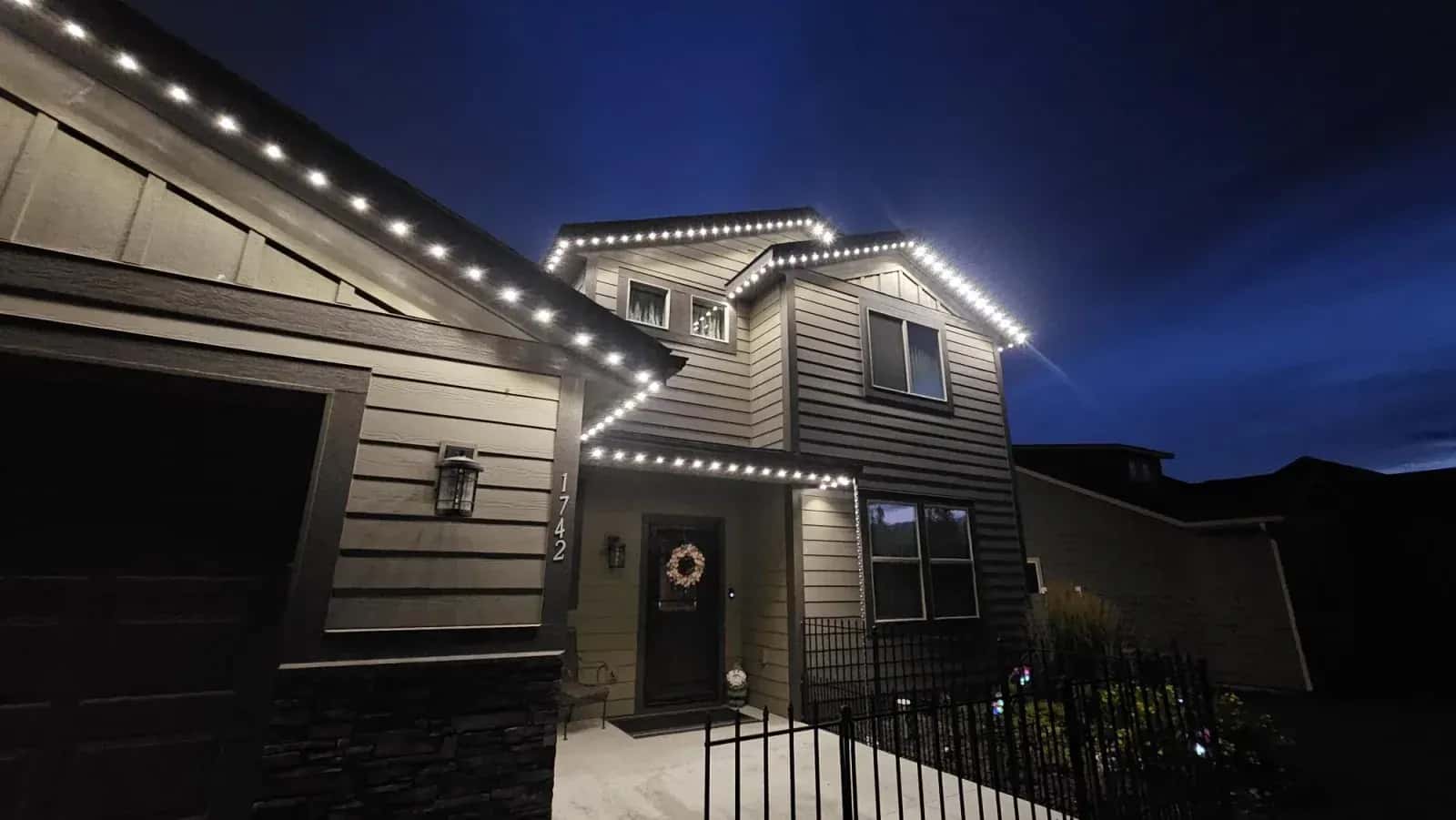
This is the mode nobody expects to love and almost everybody ends up using the most. Set to a warm white, permanent track lighting reads like tasteful architectural accent lighting rather than a holiday display. It traces your rooflines, gables, and peaks with a clean, even wash that makes a house look finished after dark.
For most homeowners this everyday warm-white setting runs the majority of the year. It's the difference between a house that disappears at night and one that has real curb appeal at 9 p.m. in February. Quality permanent systems let you dial the colour temperature and brightness, so you can land on a warm, inviting tone instead of the harsh blue-white that cheaper products default to. If you're weighing permanent lighting purely on the holiday factor, this is the feature that quietly justifies the whole install.
Curb Appeal and Resale
Even, intentional exterior lighting is one of the cheapest ways to make a home look well cared for from the curb. It highlights good architecture, evens out the dark spots that porch lights miss, and gives an evening a warmth that spotlights alone can't. For anyone thinking about selling down the road, clean roofline lighting photographs well and helps a listing stand out in the winter months when most Ontario homes look flat and grey after 5 p.m.
Game Day and Team Colours
Southwestern Ontario takes its sports seriously, and this is one of the most-used features once people realize it exists. Light the house in blue and white for the Leafs, blue and gold when the London Knights are on a run at Budweiser Gardens, or green and white during Grey Cup season. It also works for a kid's minor hockey or ringette team colours, school spirit nights, or a graduation. It's a small thing that gets a genuine reaction from neighbours and from the people who live there.
Security and Dusk-to-Dawn Lighting
A lit exterior is a real deterrent, and permanent lighting handles this without any thought once it's scheduled. Set the system to warm white on a dusk-to-dawn schedule and your roofline lights every night automatically, no timers to reset and nothing plugged in at an outlet. Because the lights outline the full perimeter of the roof rather than just a doorway, they eliminate the shadowed corners that a single motion light leaves dark.
- Automatic on/off tied to sunrise and sunset, adjusting through the year as Ontario daylight shifts.
- A lived-in look while you're away, since the schedule runs whether you're home or not.
- Even coverage around the whole house instead of one bright spot by the front door.
- Low running cost, because modern LEDs draw very little power even across a full roofline.
Parties, Celebrations, and Everyday Moments
The lights become part of how you host. A backyard summer party, a milestone birthday, an engagement, a gender reveal, or a graduation all get a backdrop with a couple of taps. Colour-cycle and animated scenes turn the exterior into something festive for the evening, then it's back to warm white by morning. It's the kind of thing you don't plan to use often and then reach for constantly, precisely because there's no setup cost to using it.
Why Year-Round Use Is the Case for Permanent Over Seasonal
Here's the honest math. Temporary Christmas lights, whether you hang them yourself or hire a seasonal installer every year, cost time or money each season and get used for roughly six weeks. Permanent lighting is a larger one-time investment, and financing spreads that out, but it's used almost every night of the year across all the purposes above. When you divide the cost by how often the system is actually on, permanent lighting is the more sensible option for anyone who was going to light their house each December anyway. You also stop paying the recurring cost of a seasonal install, and you never get on a ladder in November or take anything down in January.
This is where a professionally installed, architectural-grade track system separates itself from a plug-in strip you'd find at a big-box store. The track is colour-matched to your trim and tucked into the soffit so it nearly disappears in daylight, the wiring is done cleanly to code, and the LEDs are rated for Ontario winters. That's what lets the same system be subtle warm-white curb appeal on a Tuesday and a full holiday display in December without ever looking like leftover Christmas lights in July.
If you're weighing this for a home in London, St. Thomas, Strathroy, Woodstock, Ingersoll, Tillsonburg, or a surrounding town, the best next step is a free, no-pressure quote so you can see real numbers for your roofline. Head to our contact page at /contact to book one, or try the /cost-estimator to get a ballpark in a couple of minutes. Financing is available, and we're happy to walk through which features you'd actually use before you decide anything.
Frequently asked questions
Do permanent house lights only work at Christmas?
No. The same installed system changes to any colour on demand, so it covers every holiday, game-day team colours, everyday warm-white accent lighting, and dusk-to-dawn security lighting. Most homeowners run warm white the majority of the year and only switch to festive colours for specific occasions.
What do most people actually use permanent lights for the rest of the year?
Warm-white everyday accent lighting is by far the most-used setting. It traces your rooflines cleanly for curb appeal and doubles as automatic dusk-to-dawn security lighting. Holidays and game days are the fun extras, but the everyday warm-white mode is what runs most nights.
Can I set the lights to a warm white so they don't look like Christmas lights?
Yes. Quality RGBW systems produce a proper warm white and let you adjust brightness, so the roofline looks like intentional architectural lighting rather than holiday colour. The track itself is colour-matched to your trim and tucked into the soffit, so it stays subtle in daylight too.
Is running permanent lighting every night expensive in Ontario?
Running cost is low. Modern LEDs draw very little power even across a full roofline, so a nightly dusk-to-dawn warm-white schedule adds only a small amount to your hydro bill. The bigger saving is not paying for a seasonal install every year and never replacing worn-out light strings.
How is a permanent system better value than hiring a seasonal Christmas light installer?
A seasonal install is a recurring yearly cost for about six weeks of use. A permanent system is a one-time investment, with financing available, that's used almost every night for holidays, everyday lighting, and security. Divided by how often it's actually on, permanent lighting is the more sensible choice for anyone who lights their home each December anyway.
Which towns around London do you install in?
We serve London and across Southwestern Ontario, including St. Thomas, Strathroy, Woodstock, Ingersoll, Tillsonburg, and surrounding towns. You can request a free quote at /contact or get a quick ballpark with our /cost-estimator.
Want a number for your own home?
Get a fast ballpark with our cost estimator, or book a free, no-pressure site visit and we'll measure your exact roofline. Financing over 24 months at 10% APR is available on approved credit.
Related guides
Are Permanent Christmas Lights Worth It? An Honest Cost-and-Value Breakdown
A straight answer on permanent LED Christmas lights: when they pay for themselves versus a seasonal installer, how long they last, and who should skip them.
Read guideDoes Permanent Lighting Increase Home Value? An Honest Look for Ontario Homeowners
Permanent roofline lighting is often sold as a home-value upgrade. Here is a straight answer on curb appeal, dusk listing photos, buyer perception, energy cost, durability, what realtors actually say, and how to hand the system over to a buyer.
Read guideQuestions to Ask a Permanent Lighting Installer Before You Sign Anything
The questions that separate a system you will still love in year seven from one you will be paying to fix in year two: hardware, warranty, who answers the phone, insurance, the quote and the calendar.
Read guide