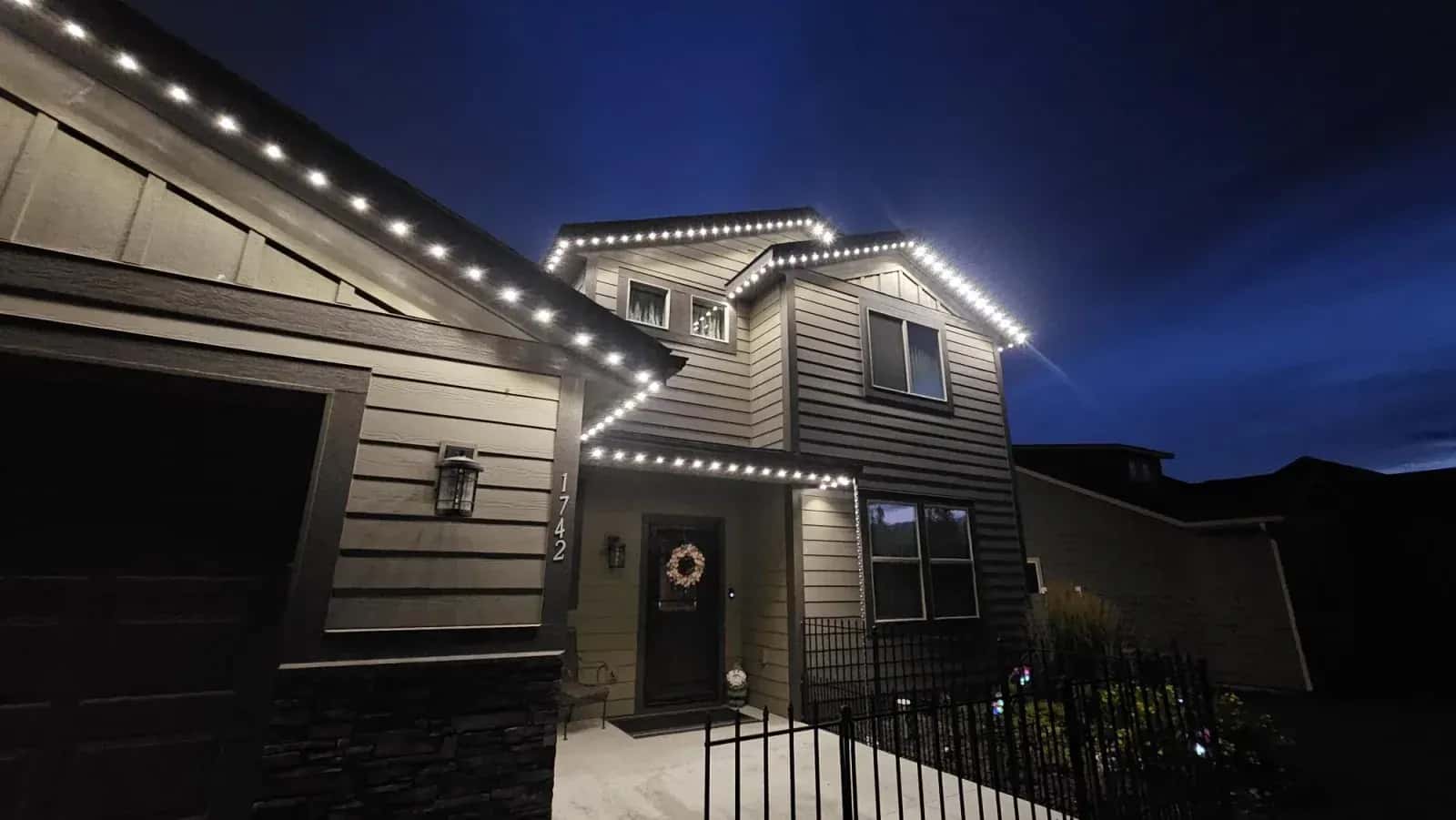
Permanent Lighting for Businesses: Storefronts, Plazas, Offices and More
A practical guide for owners and property managers on using permanent LED roofline lighting to replace annual lift crews, run brand colours, and keep commercial properties lit on a schedule.
Most of what is written about permanent LED lighting is aimed at homeowners, but a growing share of the work we do across London and Southwestern Ontario is on commercial buildings: strip plazas on Wonderland Road and Wellington Road, restaurants in Wortley Village and downtown, dealerships along Dundas, offices, churches, farm shops and multi-unit residential. The reasons a business installs permanent lighting are different from the reasons a homeowner does, and so are the questions. This guide covers the commercial side specifically: which properties it suits, what it replaces, how scheduling and multi-building control work in practice, and what you should expect a commercial quote to include.
Who installs permanent lighting on a commercial property
The common thread is a building with a visible roofline, a reason to look good after dark, and someone who is tired of paying for the same seasonal job every year. In practice that includes:
- Retail storefronts and strip plazas, where a lit roofline makes the whole property read as open and maintained, and where holiday lighting is expected by tenants and customers.
- Restaurants, pubs and cafes, which trade heavily on curb appeal in the evening and often want a warm, inviting look every night rather than only in December.
- Offices and professional buildings, where a clean architectural wash signals a well-run property to clients arriving after 5 p.m. in winter.
- Churches and community buildings, which host evening services and events through the darkest months and often have peaks and gables that lighting flatters.
- Farm markets, garden centres and rural shops, where the building sits back from a dark road and lighting doubles as wayfinding.
- Multi-unit residential and condo buildings, where a property manager wants consistent holiday lighting across the whole frontage without relying on individual residents.
- Car dealerships, self-storage and industrial frontages, with long, straight rooflines that look dramatic when lit.
What it replaces: the annual lift-crew cycle
For a homeowner, the alternative to permanent lighting is a ladder. For a commercial property, it is usually a contractor with a boom lift, twice a year. Somebody books the crew in November, the lift shows up and blocks a few parking spaces for a morning, temporary strings go up with clips and zip ties, and then the same thing happens in reverse in January. Every year the strings are a little more tired, a section fails mid-season, and someone has to decide whether it is worth another call-out to fix three dark metres over the pharmacy.
That cycle has costs beyond the invoice: parking disruption, the liability of a lift operating around customers, damage to fascia from repeated clipping, and the simple management time of booking and chasing the work. Permanent track ends the cycle. The aluminum channel goes up once, in one visit for most single buildings, and then nothing comes down. Colour changes, holiday switches and scheduling all happen in the app, from anyone with access, at any time. The lift comes back only if something needs physical service, which on a well-installed system is rare.
Brand colours, seasonal themes and the everyday look
Every point on the track is an individually addressable RGBW LED, which means the same hardware can do three quite different jobs for a business.
Brand colours first. If your logo is a specific blue and orange, the roofline can be that blue and orange, as a solid wash or alternating along the run. This is the feature that sells owners once they see it: the building becomes part of the signage. Franchises with strict brand standards can save exact colour values in the app so every location matches.
Seasonal switching second. The holidays are still the main event for most retail properties, and the app carries presets for warm white, red and green, icicle blue, multicolour and animated chases. Beyond December, orange for Halloween, red and white for Canada Day, or your local team's colours during the playoffs are a tap away, and you can schedule them weeks ahead.
And the other 300 nights: a plain, dimmed warm white. It reads as architectural lighting rather than decoration and makes the property look occupied and cared for. Because each LED point draws about 0.3 watts, running the whole roofline every evening is a modest line on the hydro bill next to the parking-lot and sign lighting most properties already pay for.
Scheduling around opening hours
Homeowners usually set dusk-to-bedtime. Businesses have more to think about, and the scheduling tools handle it. Typical setups we configure at handover:
- Dusk to close, plus an hour, so the property looks open while customers are still arriving and leaving, then goes dark or drops to a low security level.
- Dusk to dawn at low brightness for properties where overnight visibility matters, such as plazas with late-night tenants or buildings on quiet rural roads.
- Separate weekday and weekend schedules, which suits restaurants and churches with different hours on different days.
- Seasonal overrides, where a holiday scene takes over the normal schedule for a date range and hands back automatically afterward.
- Manual override from a phone for events, so a manager can bring the building up to full brand colours for an evening launch without touching the standing schedule.
- All of it runs on the controller itself using local sunset times, so it keeps working through Wi-Fi hiccups and clock changes without anyone on site.
Controlling several buildings or a whole plaza
This is where commercial installs differ most from residential. A plaza with eight storefronts is not one lighting job, it is one system with eight zones, and the control has to reflect how the property is actually managed.
Each building, or each tenant frontage on a shared roofline, is set up as its own zone in the app. A property manager holding the master account can run the entire plaza in one scene, set a plaza-wide schedule, or hand a single tenant control of their own frontage so a restaurant can go to its brand colours without affecting the dry cleaner next door. Managers responsible for several properties across London, St Thomas and Woodstock can hold them all in one account and switch between sites without driving anywhere. When a tenant changes, access is revoked and reassigned in minutes rather than by re-keying anything physical.
Safety and security lighting
A lit roofline is not a replacement for proper parking-lot lighting, but it does real work at the building edge. It brightens entrances and walkways under the canopy, removes the dark band along the fascia where cameras struggle, and makes it obvious from the road that a property is watched and maintained. Several of our commercial clients run the system at a low white overnight for exactly this reason and treat the holiday colours as a bonus. If your insurer or security contractor has asked about exterior lighting at entrances, a permanent roofline run is a straightforward way to address it without adding pole lights.
How the install works on a commercial building
The hardware is the same architectural-grade system we use on homes: rigid aluminum track colour-matched to the fascia, sealed to IP67, rated to -40°C, with CSA-approved components and LEDs rated for 50,000 hours. What changes on a commercial job is the logistics.
- Access: most commercial rooflines need a lift rather than ladders. We plan the lift route, where it will park, and how to keep customer access open. Early-morning or after-hours work is common for busy retail.
- Power: the controller and power supply connect to a GFCI-protected outlet. Larger buildings may need more than one power point along the run, and we identify these on the site visit.
- Long runs: plazas can involve hundreds of feet of track. The system is sectioned so a fault in one area never takes down the whole frontage, and so tenant zones line up with real unit boundaries.
- Wi-Fi: the controller needs a network connection for app control. On a commercial property that often means coordinating with whoever manages the building network, or installing a dedicated connection.
- Timing: a single storefront or small office is typically a one-day job. A full plaza is usually scheduled over a few days to keep disruption low.
A property manager's workflow, before and after
Before: October reminder to book the lighting contractor. Chase a quote, confirm a date, warn tenants about the lift, field the complaint when three metres go dark in December, book the removal, repeat next year. After: a standing schedule runs the everyday look. In late November the manager opens the app, applies the holiday scene to the whole plaza, and closes it. In January they switch back. A tenant's brand colours for a sale weekend take a minute. Physical visits only happen if a section fails, and the 5-year parts warranty covers the components.
What a commercial quote covers
Because commercial layouts vary so much, we always start with a free site visit rather than a phone estimate. A proper commercial quote should include, and ours does:
- Measured track length for every roofline, peak and canopy edge you want lit, with a drawing showing what is included.
- Track colour matched to the existing fascia or trim so the channel disappears in daylight.
- Controller and power supply locations, the GFCI outlets they will use, and whether any additional outlet is needed from an electrician.
- Zone layout, especially for multi-tenant properties, and who will hold which level of app access.
- Lift and access plan, including any after-hours work and how parking will be managed.
- Warranty terms: 5 years on parts, 1 year on workmanship, and what a service call looks like after that.
- Volume pricing for plazas and multi-building portfolios, and financing over 24 months at 10% APR on approved credit if you would rather treat it as an operating cost than a capital one.
You can get a ballpark for a single frontage with our cost estimator, but for anything with more than one building or tenant, the site visit is where the real number comes from. Call (519) 914-3404 or book through /contact. One honest note to close: permanent lighting suits buildings with a defined roofline and a reason to be seen after dark. A windowless warehouse on a back lot will not get much from it. A plaza, a restaurant, a church on a corner or an office people visit in the evening almost always does, and the happiest owners are the ones who use it every night rather than only in December.
Frequently asked questions
Can one person control lighting on several buildings?
Yes. A property manager can hold multiple buildings or a whole plaza in one app account, run them together or separately, set property-wide schedules, and give individual tenants control of just their own frontage. Access can be reassigned in minutes when tenants change.
Does the system show our brand colours accurately?
Each LED point is individually addressable RGBW, so you can set specific colour values and save them as a scene. Solid washes, alternating patterns and animated effects in your brand colours are all possible, and the same saved scene can be applied across multiple locations for consistency.
Will the lights hold up on a commercial building in an Ontario winter?
The track and LEDs are sealed to IP67, rated to -40°C and use CSA-approved components, the same hardware as our residential installs. Nothing comes down for winter. Long commercial runs are sectioned so a fault in one area never affects the rest of the frontage.
How disruptive is a commercial install?
A single storefront or small office is usually one day. Plazas are scheduled over a few days, often early morning or after hours, with a lift plan that keeps customer parking and entrances open. We coordinate timing with you and your tenants before work starts.
Do you offer pricing for plazas and multiple properties?
Yes. Volume pricing applies to plazas and multi-building portfolios, and 24-month financing at 10% APR is available on approved credit. Every commercial quote starts with a free site visit so the number reflects the actual rooflines, zones and access on your property.
Want a number for your own home?
Get a fast ballpark with our cost estimator, or book a free, no-pressure site visit and we'll measure your exact roofline. Financing over 24 months at 10% APR is available on approved credit.
Related guides
Are Permanent Christmas Lights Worth It? An Honest Cost-and-Value Breakdown
A straight answer on permanent LED Christmas lights: when they pay for themselves versus a seasonal installer, how long they last, and who should skip them.
Read guideDoes Permanent Lighting Increase Home Value? An Honest Look for Ontario Homeowners
Permanent roofline lighting is often sold as a home-value upgrade. Here is a straight answer on curb appeal, dusk listing photos, buyer perception, energy cost, durability, what realtors actually say, and how to hand the system over to a buyer.
Read guideQuestions to Ask a Permanent Lighting Installer Before You Sign Anything
The questions that separate a system you will still love in year seven from one you will be paying to fix in year two: hardware, warranty, who answers the phone, insurance, the quote and the calendar.
Read guide