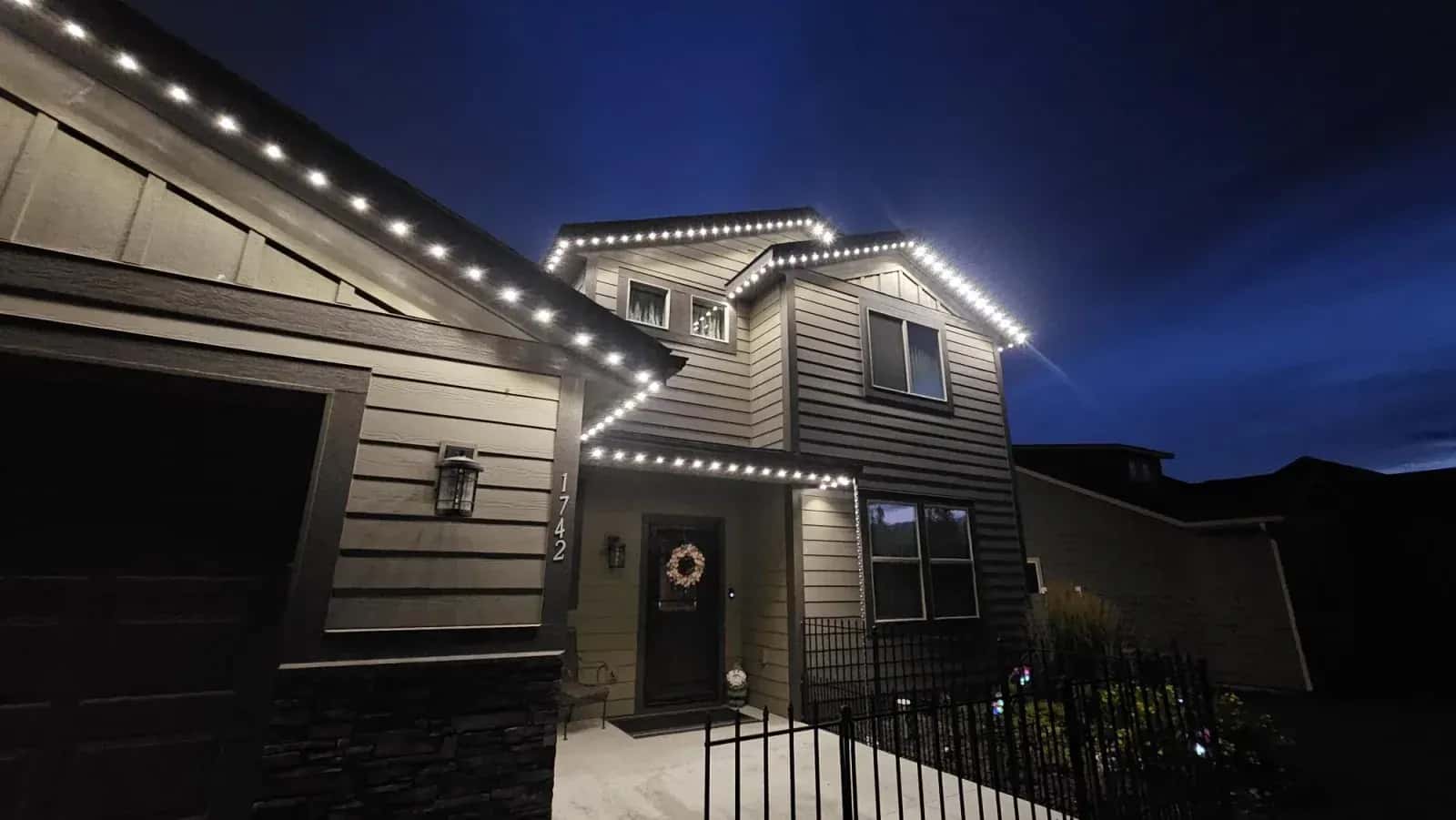
Warm White vs Cool White: A Colour Guide for Permanent Roofline Lighting
Colour temperature is the single decision that most shapes how permanent lighting looks on your house. Here is how 2700K, 3000K, 4000K and 6500K read on brick, stone, white vinyl and dark modern exteriors, plus how to test it before you commit.
When people picture permanent LED lighting they usually picture colour: red and green in December, orange in October. But the setting your house will wear on most nights of the year is white, and the exact shade of white makes a bigger difference to the finished look than almost anything else you decide. Get it right and the house looks like it was designed with the lighting in mind. Get it wrong and a beautiful brick home can look like a car dealership. This guide explains colour temperature in plain terms, matches it to the common exterior materials we see across London and Southwestern Ontario, and shows you how to test it on your own home before you settle on anything.
What colour temperature actually means
White light is not one thing. It ranges from the orange glow of a candle to the blue-white of a clear noon sky, and that range is measured in kelvin (K). Lower numbers are warmer and more orange; higher numbers are cooler and more blue. It is a little counter-intuitive, because a higher temperature sounds like it should be warmer, but the scale comes from physics rather than mood. The four settings that matter for roofline lighting are:
- 2700K, often called warm white. This is the colour of a traditional incandescent bulb or a candle. It is soft, amber-tinged and flattering, and it is the most popular everyday setting on our installs.
- 3000K, sometimes labelled soft white. Slightly cleaner than 2700K but still clearly warm. A good compromise if 2700K feels too yellow on a lighter exterior.
- 4000K, a neutral or natural white. Neither obviously warm nor obviously cool. Reads as a clean, modern white without tipping into blue.
- 6500K, daylight white. Crisp and very bright-looking. Against a dark sky it reads distinctly blue, which is why it is sometimes used deliberately for a cool icicle effect in winter.
Our system uses RGBW LEDs, which means every point has a dedicated white diode in addition to the red, green and blue ones. That dedicated white chip is what lets the controller produce a true 2700K or 4000K instead of faking white by mixing colours, and it is why the everyday setting looks like proper architectural lighting rather than a holiday product left on.
Matching colour temperature to your exterior
Light does not exist on its own. It bounces off your brick, siding and trim, and the surface it lands on changes how the colour reads from the street. The same 2700K that looks rich on red brick can look dingy on bright white vinyl. Here is what we have found works across the housing stock in the London area, from the older brick in Old North and Wortley Village to the newer subdivisions in the north and southwest of the city and out through St. Thomas, Strathroy and Woodstock.
Red, orange and brown brick
The classic Southwestern Ontario brick home wants warm light. At 2700K the brick glows and the mortar lines soften, which is exactly the look people are after when they say they want the house to look cozy. Cool white on red brick is the most common mistake we see, because the blue tint fights the orange in the clay and leaves the wall looking flat and grey. If 2700K feels slightly too orange on very red brick, step up to 3000K, but stay in the warm range.
Natural stone, tan brick and stucco
Limestone, fieldstone, cultured stone and the buff-coloured brick common on newer builds all sit comfortably under warm to soft white. These surfaces have a lot of texture, and warm light raked along them from the soffit picks out that texture beautifully. 3000K is often the sweet spot here, since it keeps the warmth without turning pale stone yellow. The same goes for cedar shakes, timber brackets and stained wood doors: wood under cool light looks grey and tired, and under warm white it looks like furniture.
White or cream vinyl siding
White siding is the one place where very warm light can work against you. A 2700K wash on bright white vinyl can make the siding look dated, like the yellowed plastic of an old appliance. Many homeowners with white or cream exteriors prefer 3000K to 4000K, which keeps the siding looking white while still feeling like house lighting rather than a parking lot. Your trim colour matters too: white siding with black windows and trim usually looks sharpest at 4000K.
Dark modern exteriors: black, charcoal, deep grey
Dark, modern homes are having a moment across new builds in the region, and they are the one style where cool white is a genuinely good choice. Charcoal board-and-batten, black brick and dark fibre cement panels absorb warm light and can look muddy under 2700K. Neutral 4000K brings out the crispness of the lines, and some owners of very contemporary homes run 5000K to 6500K deliberately for a gallery-like effect. Colour-matched black track disappears against these exteriors, so the light appears to come from nowhere.
Brightness etiquette: the setting nobody talks about
New owners almost always start at 100 percent brightness because it is impressive on the first night. Within a week most people dial it back, and for good reason. Full brightness flattens the shadows that give a house depth, spills light into upstairs bedrooms, and is the thing neighbours notice when a roofline system is installed on their street. A setting between 40 and 70 percent usually looks more expensive, not less, because the light traces the architecture rather than shouting from it.
- Aim lower than you think. Stand at the curb, turn the brightness down until the roofline still reads clearly but the wall below is softly lit, then save that as your everyday scene.
- Think about the neighbours. If a run of track faces a neighbour's bedroom window, assign it to its own zone and give it a lower brightness or an earlier off time.
- Use a schedule, not the switch. Sunset to around 11:00 PM covers the hours when anyone is looking. Running all night at full brightness is rarely necessary unless you specifically want security lighting.
- Winter is brighter. Snow on the ground reflects light back up at the house, so a setting that was perfect in September may want a small reduction in January.
Single colours versus patterns
Because every LED point can be told what to do individually, the app can run alternating colours, chases, twinkles and gradients. That capability is wonderful in December and October, and it is worth having. But for everyday use, one static colour along the whole roofline is what makes a home look architecturally lit. The moment the lights alternate or move, the house reads as decorated rather than designed, and that is fine for a holiday and less fine on a Tuesday in April.
If you do want colour outside the holidays, a single deep tone such as a soft amber, a muted blue or a warm rose at reduced brightness can look intentional and elegant, particularly on a modern exterior. Where things go wrong is speed and density: fast chases and every point a different colour turn to visual mush from across the street. Slow effects with a repeat every two or three points hold up far better at distance.
What looks premium from the street
Having lit hundreds of homes across the region, we have a fairly consistent picture of what makes people slow down as they drive past, and it is rarely the brightest house. It is the one where the light is even end to end with no dark gaps, where the colour suits the material, where the peaks and gables are traced rather than flooded, and where the track itself is invisible in daylight because it was colour-matched to the soffit and fascia. Restraint reads as money. The house that runs warm white at 50 percent on a schedule looks like it came with the lighting; the one running a rainbow chase in March looks like it came with a remote.
How to test colour at the site visit and after install
You should never have to choose a colour temperature from a brochure. Every Forever Lights install starts with a free site visit, and colour is part of the conversation. Here is how to make the most of it:
- Ask to see a sample of the track against your soffit and fascia in daylight. Colour-matching the track is what keeps it invisible when the lights are off, and it is easier to judge in person than from photos.
- Bring your own reference. If you have seen a house in your neighbourhood whose lighting you like, note the street or take a photo at night. We can usually tell you what temperature and brightness it is running.
- Tell us about the materials. Brick colour, siding, trim, stone accents and the front door all feed into a recommendation, and if your home mixes several we will talk through which one should lead.
- Plan the zones now. If one side faces a neighbour or a bedroom, mention it so the runs can be zoned separately from the start.
- Know that nothing is locked in. On the evening of the install we walk you through the app and stand at the curb with you while you try 2700K, 3000K and 4000K on your own house. Whatever you pick is saved as a scene and can be changed any night from your phone.
That last point is the one to remember. With temporary lights, colour is a purchase decision you make in a store aisle in November. With an addressable RGBW system, colour is a setting. You can run warm white all winter, try a neutral white when the snow melts, and switch back if you miss the glow. The site visit gets you a confident starting point; the app lets you refine it for as long as you own the house.
If you are weighing a permanent lighting install for a home in London, St. Thomas, Strathroy, Woodstock, Ingersoll, Tillsonburg or the surrounding area, the easiest first step is to get a ballpark from our cost estimator, then book a free site visit at /contact or call (519) 914-3404 and we will bring the samples. Financing over 24 months at 10 percent APR is available on approved credit, and the colour conversation is one of the parts of the job we enjoy most.
Frequently asked questions
What is the most popular colour temperature for permanent roofline lighting?
Warm white, around 2700K to 3000K, is by far the most common everyday setting on our installs across London and Southwestern Ontario. It flatters brick, stone and wood and makes a home look welcoming rather than commercial. Neutral 4000K is the usual choice for white vinyl and dark modern exteriors.
Is warm white or cool white better for a brick house?
Warm white. Red, orange and brown brick contain a lot of warm tone, and a 2700K or 3000K light brings that out. Cool white fights the clay colour and tends to leave brick looking flat and grey. If 2700K feels slightly too orange on very red brick, 3000K is a good middle ground.
Can I change the colour temperature after the lights are installed?
Yes, any time, from the app. Because the LEDs are RGBW with a dedicated white diode and every point is individually addressable, you can move between 2700K, 3000K, 4000K and 6500K, adjust brightness, and save each look as a scene. Nothing about the colour is fixed at install.
How bright should I run my roofline lights?
Most homes look best between 40 and 70 percent brightness. Full brightness flattens the architecture, spills into upstairs windows and is what neighbours notice. Stand at the curb, lower the brightness until the roofline still reads cleanly, and save that as your everyday scene on a sunset-to-bedtime schedule.
Will the track match my soffit colour?
Yes. During the free site visit we colour-match the aluminum track to your soffit and fascia, typically white, black, brown or grey, so that in daylight it reads as trim rather than a light fixture. You can see a sample held against your home before anything is ordered.
Want a number for your own home?
Get a fast ballpark with our cost estimator, or book a free, no-pressure site visit and we'll measure your exact roofline. Financing over 24 months at 10% APR is available on approved credit.
Related guides
Are Permanent Christmas Lights Worth It? An Honest Cost-and-Value Breakdown
A straight answer on permanent LED Christmas lights: when they pay for themselves versus a seasonal installer, how long they last, and who should skip them.
Read guideDoes Permanent Lighting Increase Home Value? An Honest Look for Ontario Homeowners
Permanent roofline lighting is often sold as a home-value upgrade. Here is a straight answer on curb appeal, dusk listing photos, buyer perception, energy cost, durability, what realtors actually say, and how to hand the system over to a buyer.
Read guideQuestions to Ask a Permanent Lighting Installer Before You Sign Anything
The questions that separate a system you will still love in year seven from one you will be paying to fix in year two: hardware, warranty, who answers the phone, insurance, the quote and the calendar.
Read guide