How Much Do Permanent Christmas Lights Cost in Ontario? (2026 Pricing Guide)
A plain-English 2026 breakdown of what permanent LED Christmas lights actually cost in Southwestern Ontario, from per-foot pricing to what makes one quote higher than another.
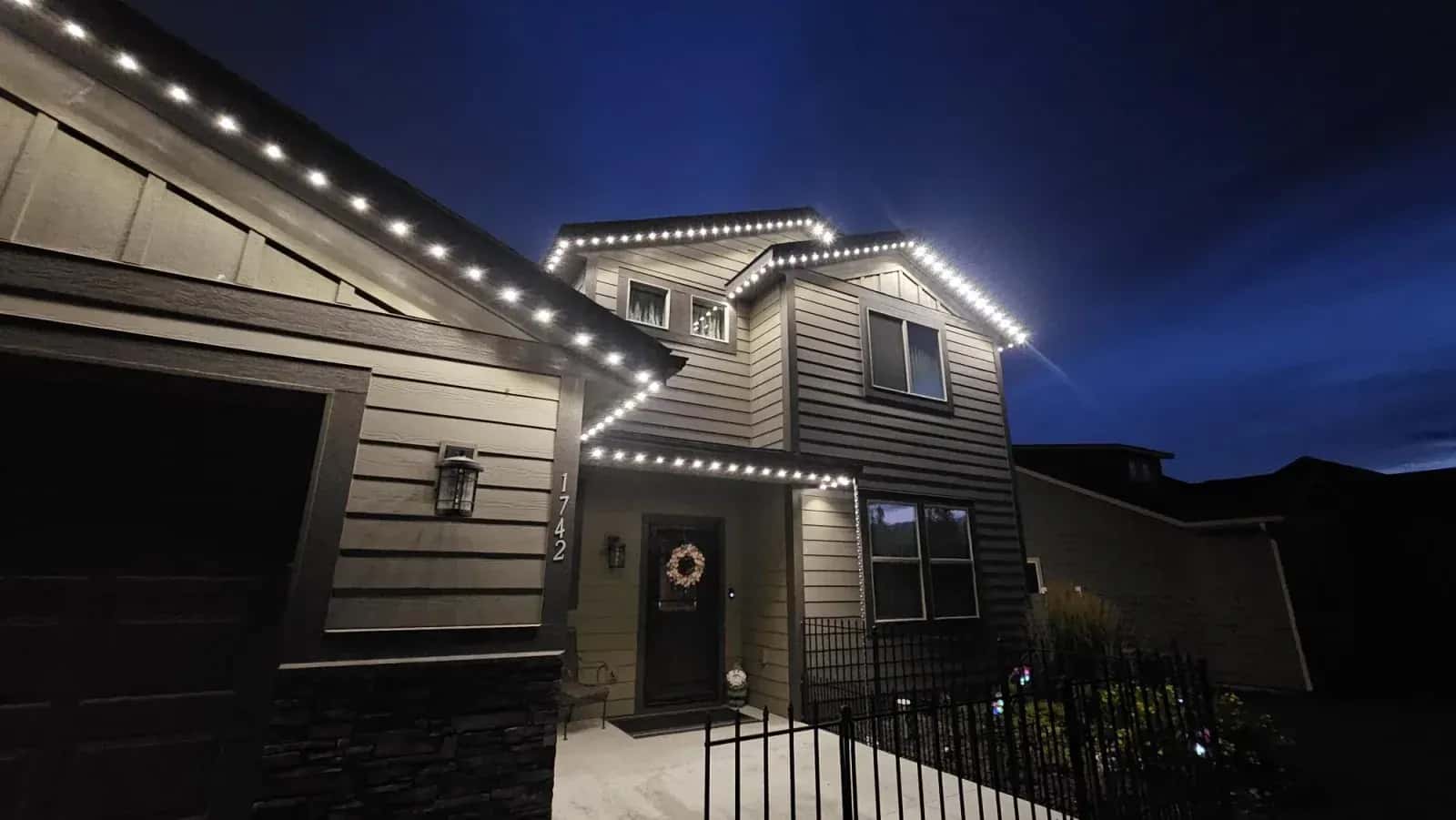
Permanent Christmas lights, sometimes called permanent holiday lighting or architectural track lighting, have quietly become one of the most popular exterior upgrades in Southwestern Ontario. Instead of climbing a ladder every November and taking everything down in January, you get a discreet channel of individually controllable LEDs tucked into your roofline and soffits, ready for Christmas, Halloween, Canada Day, a hockey win, or just warm everyday accent light. The most common question we hear is also the most reasonable one: what does it actually cost?
This guide gives you defensible 2026 pricing ranges for Ontario, explains how installers arrive at a number, and shows what makes one quote higher than another. These are market ranges to help you budget and compare, not a binding quote. Every home is different, and the only way to get an exact price is a measured estimate. Where a number matters, we have kept it to a realistic range rather than a single figure.
The short answer: per linear foot
Professional permanent lighting is almost always priced per linear foot of track installed. Across Ontario in 2026 you will see quotes ranging from roughly $25 to $45 per linear foot fully installed, and our own pricing generally sits at the lower end of that band, from about $16 to $21 per foot on a typical 100 to 250 foot home. That price includes the LED track, the diodes, the transformer and controller, mounting, wiring, and the labour to run it cleanly along your soffit or fascia.
Per-foot pricing is genuinely useful because it lets you compare quotes on the same footing. If one company quotes $30 per foot and another quotes $42, you can ask what accounts for the gap, whether it is a better diode, a wider colour range, a longer warranty, or simply a higher margin. A quote that only gives you a lump sum with no measurement behind it is harder to judge. One thing to watch for: the per-foot rate is not flat. Shorter runs carry a higher rate because the fixed costs of a job do not shrink with the length.
Typical home sizes and price ranges
The next thing that determines your total is how much roofline you are lighting. Most single-family homes fall into a fairly predictable band once you measure the runs where track will actually go.
- Smaller bungalow or townhome, roughly 100 to 140 linear feet: about $2,100 to $3,200 installed with us.
- Average two-storey home, roughly 150 to 200 linear feet: about $2,800 to $4,150 installed with us.
- Larger or more complex home, roughly 250 linear feet and up: about $4,150 to $6,900 installed with us.
These bands are our installed pricing for a professionally installed, architectural-grade system with a proper controller and app, not a plug-in consumer kit. Your measured footage may land higher or lower depending on the shape of your home. A long, simple ranch bungalow carries a lot of feet at the lower end of the per-foot rate, while a compact two-storey with lots of peaks and dormers takes more time per foot. Our cost estimator will put your own home in the right range in under a minute.
What actually drives the cost
Two homes with the same total footage can land at different prices. Here is what moves the number, and why.
Roofline complexity
A straight, continuous fascia is quick to install and uses track efficiently. Multiple gables, dormers, peaks, tight corners, and returns each add labour, connectors, and cut track. More complexity means more time on the ladder and more material waste, so it nudges the per-foot rate up.
Number of storeys and access
Height is a real cost factor. A single-storey home is faster and safer to work on than a three-storey with steep pitches, limited ladder footing, or areas that need scaffolding or a lift. The harder and slower the access, the more the labour portion of your quote grows.
Controller and smart features
The brain of the system matters. A quality controller with a stable app, scheduling, zones, scenes, and reliable Wi-Fi or Bluetooth costs more than a basic one, and it is the part you will interact with every day. Systems that let you split your roofline into independently controlled zones, or run animated effects, carry more hardware and firmware value.
Colour range: RGB versus RGBW
This is a big one for everyday use. Basic RGB systems mix red, green, and blue to make colours, which is great for holidays but produces a slightly bluish or greenish white. RGBW adds a dedicated warm-white diode, so your everyday setting looks like clean, inviting warm light rather than a compromised white. If you plan to run the lights as year-round accent lighting and not just for Christmas, RGBW is usually worth the difference.
Diode quality, spacing, and warranty
Tighter diode spacing gives a smoother, more continuous line of light instead of visible dots, and higher-grade diodes hold their colour and brightness longer. A longer, clearly written warranty on both product and workmanship also reflects real cost and is worth asking about, since this is a system that lives outside through Ontario winters.
Minimum jobs and why small runs cost more
Most reputable installers set a minimum job. Ours is $1,665, and across the wider market you will see minimums anywhere from about $1,500 to $2,500. That is not a cash grab. A crew still has to travel, set up, run power, mount a controller, and commission the app whether the run is 50 feet or 250 feet. On a very small run those fixed costs get spread over fewer feet, so the effective per-foot price is higher. If you are lighting only a garage or a small front elevation, expect the per-foot number to look high compared to a full house, and consider whether adding the rest of the roofline is better value per dollar.
A note for London and Southwestern Ontario homeowners
Around London, St. Thomas, Strathroy, Woodstock, Ingersoll, Tillsonburg and the surrounding towns, a few local realities shape the value equation. Our winters are hard on temporary light clips and extension cords, and getting up a ladder on icy December mornings is exactly what most people want to stop doing. A permanent system installed once, before the snow flies, removes that annual hazard entirely. The housing stock here is a good mix of straightforward ranch bungalows and two-storey homes, which tend to sit comfortably in the ranges above, and the year-round accent use lands especially well in neighbourhoods where people actually look forward to the seasonal displays. Installing in the shoulder seasons, spring through early fall, also means you are ready well ahead of the holiday rush.
Financing and getting a real number
Because a permanent system is a one-time investment that replaces years of buying temporary lights and paying for installs and takedowns, many homeowners spread the cost. Financing is available, which turns the project into a manageable monthly amount rather than a single up-front sum, and makes stepping up to RGBW or a larger run easier to justify.
The ranges here should give you a solid sense of where your home will land, but the honest answer to your exact price depends on your measured footage, your roofline, and the system you choose. If you want a ballpark in a couple of minutes, try our cost estimator at /cost-estimator to see a range tailored to your home size. When you are ready for a firm number, book a free, no-pressure quote at /contact and we will measure your roofline and walk you through the options that fit your budget.
Frequently asked questions
How much do permanent Christmas lights cost in Ontario?
Quotes across Ontario in 2026 generally run about $25 to $45 per linear foot installed. Our own pricing usually lands at the lower end, roughly $16 to $21 per foot on a typical 100 to 250 foot home, which works out to about $2,100 to $5,000 for most houses. Your exact price depends on your measured footage and roofline, so try our cost estimator or book a free measured quote.
Why is my quote higher than the per-foot range?
A few things push a quote up: complex rooflines with lots of peaks and dormers, steep pitches or difficult access, extra controllers for independently zoned sections, and tying in a detached garage or outbuilding. Short runs also cost more per foot because of the minimum job.
Is there a minimum job size?
Yes. Our minimum job is $1,665, and other installers commonly set theirs between about $1,500 and $2,500. Fixed costs like travel, setup, power and commissioning apply whether the run is short or long, so very small installs cost more per foot.
Are permanent Christmas lights worth the cost?
For many homeowners, yes. You install once, skip the annual ladder work, and get lighting you can use for every holiday plus year-round warm-white accent light. Over several seasons it often replaces the recurring cost of temporary lights and yearly install-and-takedown services.
Can I finance permanent lighting?
Yes. Financing is available, which spreads the one-time cost into manageable monthly payments and makes it easier to choose RGBW or light more of your home. Ask us for current options when you get your quote.
What is the difference between RGB and RGBW, and does it affect price?
RGB mixes red, green, and blue, which is great for colour but produces an imperfect white. RGBW adds a dedicated warm-white diode for a clean, inviting everyday light. RGBW costs a bit more but is usually worth it if you plan to use the lights year-round, not just at Christmas.
Want a number for your own home?
Get a fast ballpark with our cost estimator, or book a free, no-pressure site visit and we'll measure your exact roofline. Financing over 24 months at 10% APR is available on approved credit.
Related guides
How Permanent LED Lighting Works: A Homeowner's Guide
A plain-language look at the track, the addressable RGBW LEDs, the controller and smartphone app, and exactly how permanent lighting disappears in daylight.
Read guideHow Much Electricity Do Permanent LED Lights Use? A Worked Example for a London, Ontario Home
Watts per point, a real calculation for a typical two-storey home, how many hours the lights actually run, and what Ontario time-of-use pricing means for an evening display.
Read guidePermanent Lights on Vinyl, Aluminum and Wood Soffit: How the Track Mounts on Each
What actually holds the track up on each soffit and fascia type, how colour matching works, what we do on brick and stucco homes with no overhang, and what the site visit checks before we quote.
Read guide