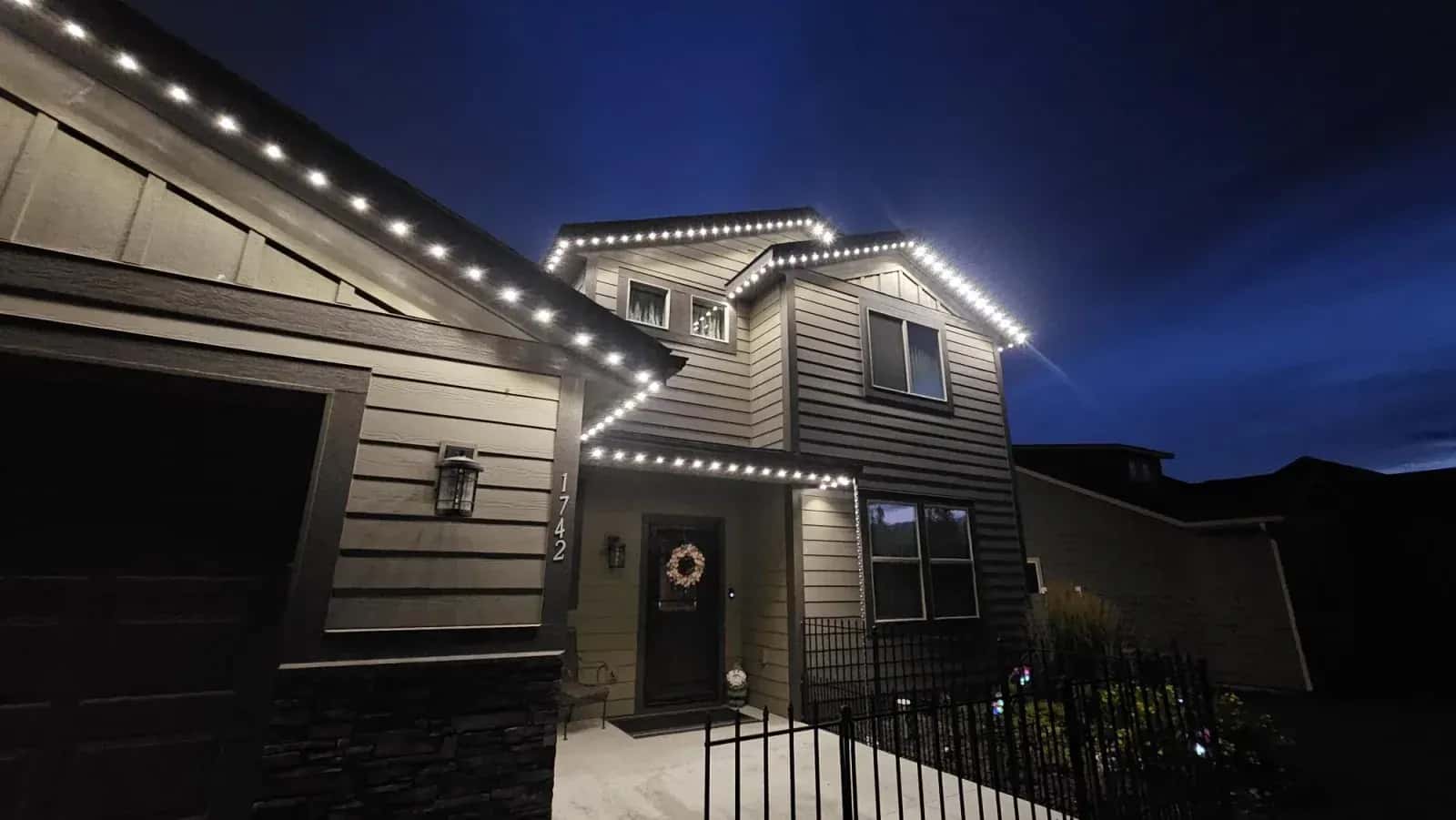
Permanent Lights on Vinyl, Aluminum and Wood Soffit: How the Track Mounts on Each
What actually holds the track up on each soffit and fascia type, how colour matching works, what we do on brick and stucco homes with no overhang, and what the site visit checks before we quote.
Every roofline in Southwestern Ontario is a little different, and the material under the eave is the first thing we look at on a site visit. A 1990s two-storey in Westmount has vinyl soffit and aluminum fascia. A century home near Wortley Village has painted wood on both. A new build in Kilworth might have aluminum throughout, and a brick bungalow in Woodstock may have almost no overhang at all. The lights are the same on every one of those houses. What changes is how the track is fastened, where the wiring goes, and how we match the colour so the track disappears in daylight.
First, what the track is and how it attaches in general
The track is a slim extruded aluminum channel that holds a sealed strip of individually addressable RGBW points. It is cut to length on site and fastened with screws at regular intervals, mitred at corners and peaks, and joined with sealed low-voltage connectors between sections. The key principle on every soffit type is the same: the screws need to land in something solid. Soffit material is a covering, not a structure, so we always aim for the fascia board, the sub-fascia, the rafter tails or the framing behind the soffit, and we choose the mounting position on the eave to line up with that.
There are two positions the track can sit in. Under the soffit, tucked up against the fascia so the points face down and out, is the most common and the most invisible in daylight. On the face of the fascia, just below the drip edge, is used when the soffit is too shallow, ventilated in a way we do not want to block, or made of a material that will not hold a clean line. Both positions give the same light on the house at night.
Vinyl soffit
Vinyl is the most common soffit material on homes built in London, Strathroy, St Thomas and Ingersoll from the 1980s onward. It is a thin, flexible panel that clips into a J-channel along the wall and a receiving channel along the fascia. It expands and contracts a great deal with temperature, which in our climate means a swing from a July heat wave to a January cold snap. Two things follow from that. Vinyl will not hold a screw on its own for long, and anything fastened tightly to a vinyl panel will eventually buckle it or pull loose.
So on a vinyl soffit the track is positioned against the fascia edge of the soffit and the screws pass through the vinyl into the wood fascia board or sub-fascia behind it. The vinyl is not carrying the load; it is simply between the track and the wood. Fastener spacing is kept tight enough that the track stays straight across the vinyl's seasonal movement, and we avoid the perforated vent panels wherever we can so the attic keeps breathing. Because vinyl soffit is almost always white or a light neutral, white track is the usual colour match and sits nearly invisible from the street.
Aluminum soffit and fascia
Aluminum soffit and fascia are standard on many newer builds and on older homes that have been re-clad. Aluminum is rigid, dimensionally stable and holds a screw well, so mounting is straightforward. The track can sit under the soffit against the fascia line or on the fascia face, and either way the fasteners find the aluminum and the wood behind it. Aluminum fascia cladding usually wraps a wood fascia board, so the screw passes through the metal into solid wood and the track is held firmly along its whole length.
Colour matching is easiest on aluminum because the cladding comes in a limited range of manufacturer finishes. White, black, brown, sandalwood and the greys cover most of what we see, and we carry track in white, black and brown, with custom colour available for anything else. The aluminum track sits flush against the aluminum fascia and the two read as a single trim line in daylight.
Wood soffit and fascia
Painted or stained wood soffit is common on century homes in Old North, Old South and Wortley Village, on older streets in St Thomas and Woodstock, and on cottage-style and custom builds throughout Middlesex and Elgin counties. From a mounting point of view, wood is the most forgiving surface there is. The screws go directly into the soffit boards or the fascia and hold immediately, the track can be positioned exactly where it looks best, and there is no thin cladding to work around.
The considerations on wood are about condition and colour rather than fastening. Soft, rotted or peeling boards need to be sound before anything is mounted to them, and we will tell you if a section should be repaired first. Colour matching on wood is often a custom job, because painted trim on an older home can be any shade. We match to the fascia colour so the track blends into the existing line, and on a home with dark green or deep brown trim a custom track colour is worth the small extra step.
Brick, stone and stucco homes
Homeowners with full brick or stone fronts, common across London and Oxford County, sometimes assume the track has to attach to the masonry. It does not. Almost every brick home still has a fascia and some overhang along the roofline, and that is where the track goes. The brick is simply the backdrop the light falls on, and it happens to be one of the best backdrops there is, because warm white on red or brown brick looks richer than the same light on pale siding.
Stucco is similar. The track mounts to the fascia or the soffit above the stucco, never to the stucco itself, which can crack around fasteners and is difficult to seal. Where a stucco home has a boxed-in eave finished in the same stucco, we mount to the fascia face just below the roof edge.
Homes with little or no soffit
Some older brick homes, certain modern designs with a flush roof edge, and many garages and additions have a fascia but no soffit overhang to tuck the track under. In these cases the track mounts to the face of the fascia just below the drip edge, and the points are angled to light the wall below. If there is no fascia either, which happens on some parapet-style roofs and on masonry gable ends, we can install a slim colour-matched mounting strip or trim board to carry the track. The site visit is where we confirm which option suits the house, and we will show you photos of similar installs so you know what the finished line will look like.
Colour matching in practice
The reason a good permanent install disappears in daylight is that the track reads as part of the trim. We colour-match during the site visit by holding sample track against your soffit and fascia in daylight, not by guessing from a photo. White is right for most vinyl and light aluminum homes. Black suits modern builds with charcoal fascia and the dark trim that has become popular on new construction in Ilderton and Komoka. Brown works on many 1970s and 1980s homes with brown or sandalwood aluminum. Anything else, from the deep greens on older painted trim to a specific manufacturer grey, we order as a custom colour.
Gutter guards, downspouts and the things already on your eave
The eave is a busy place. Gutter guards, gutter brackets, downspouts, soffit vents, exterior cameras and old holiday-light hooks all live there, and they affect where the track can run. Gutter guards that overhang the fascia can shade the light or interfere with a fascia-face mount, so on those homes we usually go under the soffit instead. Downspouts are simply routed around with a short jog or a sealed connector so the light stays continuous. Existing hooks, clips and staples from years of seasonal lights are removed before the track goes on, and the holes are sealed.
Ice damming and ventilation
Ice damming is a real issue on London homes, particularly on older houses with limited attic insulation and on any roof after a heavy lake-effect snowfall followed by a thaw. The track itself is sealed to IP67 and rated to -40°C, so ice sitting on or against it does no harm. What we pay attention to is history: a fascia that has been repeatedly soaked by ice dam overflow may be soft, and a home that dams every winter needs its track placed so meltwater runs past it rather than pooling behind it. We also avoid covering soffit vents, because blocked ventilation makes ice damming worse and no light is worth a wet attic. If you have had ice dam problems, mention it on the site visit and we will plan around it.
What the free site visit checks
Every quote starts with a visit, because the soffit type and condition drive both the mounting method and the final look. Here is what we look at on every home:
- Soffit and fascia material on each roofline, and whether the mounting position should be under the soffit or on the fascia face.
- What is behind the soffit: the fascia board, sub-fascia or framing the screws will land in, and its condition.
- Linear footage of every run, including peaks, gables, dormers and the garage, which sets the point count.
- Colour match, done with physical track samples held against your trim in daylight.
- Obstacles on the eave: gutter guards, downspouts, vents, cameras and leftover hooks or clips.
- Ice dam history, soft or damaged sections, and anything that should be repaired before mounting.
- The location of a GFCI-protected outlet, the path for low-voltage wiring back to the controller, and where power injection feeds will tie in.
- Wi-Fi coverage where the controller will sit, so the app connects reliably.
From that we produce a written quote for your specific rooflines and a plan for how the track will run. The install itself is normally one day, no permit is required because the system plugs into an existing GFCI receptacle, and the work is backed by a five-year parts warranty and a one-year workmanship warranty. If you want a sense of scale before booking, our cost estimator gives a rough range from linear footage, and a call to (519) 914-3404 will get a site visit on the calendar for anywhere in London and Southwestern Ontario.
Frequently asked questions
Can permanent lights be installed on vinyl soffit?
Yes. The track is positioned along the fascia edge of the soffit and the screws pass through the vinyl into the wood fascia or sub-fascia behind it, so the vinyl never carries the load. Vinyl moves with temperature, which is exactly why adhesive and clip-on kits fail on it and a screwed aluminum track does not.
What about a brick or stone house with no soffit?
The track mounts to the fascia, not the masonry. On homes with a fascia but no overhang it goes on the fascia face just below the drip edge. Where there is no fascia at all we can add a slim colour-matched mounting strip. The site visit confirms which approach fits your home.
How do you colour-match the track to my trim?
We hold physical track samples against your soffit and fascia in daylight during the site visit. White, black and brown cover most homes, and custom colours are available for painted wood trim or specific manufacturer finishes so the track reads as part of the trim line.
Will the track interfere with gutter guards or soffit vents?
We plan around both. Gutter guards that overhang the fascia usually push the track to an under-soffit mount, and we avoid covering vented soffit panels so attic ventilation is unaffected. Downspouts are jogged around with sealed connectors so the light stays continuous.
Is ice damming a problem for permanent lights?
Not for the track, which is sealed to IP67 and rated to -40°C. It can be a problem for the fascia the track mounts to if repeated ice dam overflow has softened it, so we check condition and history on the site visit and position the track so meltwater runs past rather than pooling behind it.
Want a number for your own home?
Get a fast ballpark with our cost estimator, or book a free, no-pressure site visit and we'll measure your exact roofline. Financing over 24 months at 10% APR is available on approved credit.
Related guides
How Permanent LED Lighting Works: A Homeowner's Guide
A plain-language look at the track, the addressable RGBW LEDs, the controller and smartphone app, and exactly how permanent lighting disappears in daylight.
Read guideHow Much Electricity Do Permanent LED Lights Use? A Worked Example for a London, Ontario Home
Watts per point, a real calculation for a typical two-storey home, how many hours the lights actually run, and what Ontario time-of-use pricing means for an evening display.
Read guideHow Permanent Lights Survive Ontario Winters: Sealing, Cold Ratings and What Actually Fails
Ice storms, lake-effect snow and freeze-thaw cycles are the real test of permanent lighting. Here is what the ratings mean, why nothing comes down, and where budget systems give out.
Read guide