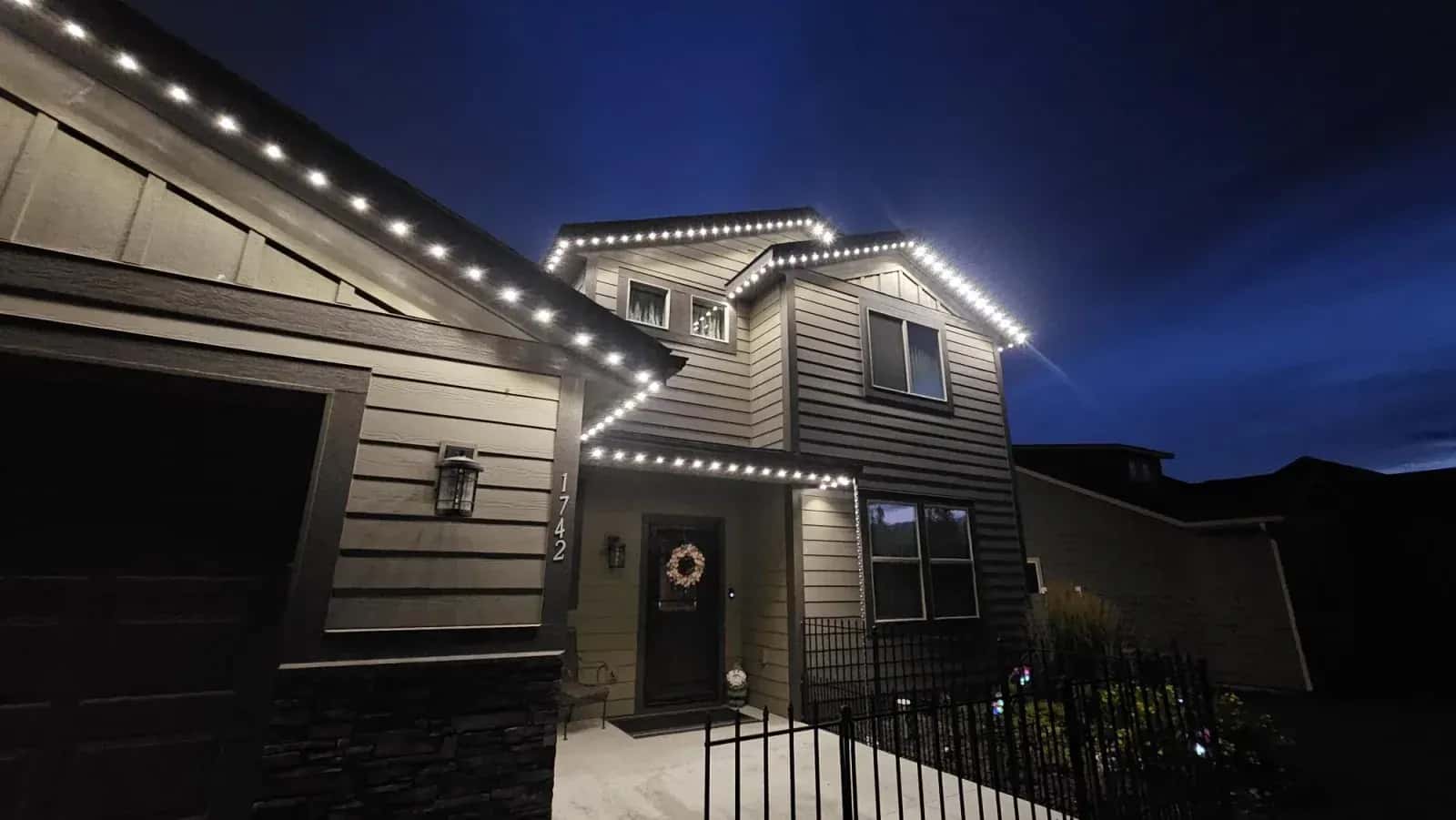
A Year of Permanent Lighting: Month-by-Month Holiday Schedule Ideas for Ontario
Twelve months of colour ideas for permanent roofline lighting, tuned to the Ontario calendar: which combos work for each holiday, how to pre-load dated schedules once, and where the line sits between festive and too much.
The first winter with permanent lighting, most homeowners in London and across Southwestern Ontario use it exactly as they expected: Christmas colours in December, warm white the rest of the time. By the second year the calendar fills in. This guide is the shortcut to that second year: the Ontario calendar month by month, colour combinations that hold up from the street, and how to load the whole year into the app once so it runs itself.
Everything below relies on one idea from the app: a scene is a saved look, and a schedule tells the controller when to play it. Your base schedule is an everyday scene, usually warm white at moderate brightness from sunset to bedtime, repeating daily. Holiday looks are added as dated schedules with a start and an end date. While a dated schedule is active it takes over from the everyday one; when it ends, the everyday schedule resumes on its own. Because the dates recur every year, you build the calendar once. Build the scene first, standing at the curb at night until the colours and brightness look right, then attach the dates.
January: New Year's and the long dark
New Year's Eve is the one night of the year when an animated scene is entirely appropriate. A slow colour cycle or a gold and white twinkle works through the evening, and some owners schedule a brighter burst around midnight. From January 2 most homes go back to warm white, though many keep the Christmas scene running to January 6. January is also when the everyday schedule matters most, because sunset in London is around 5:00 PM and the house is lit for the whole evening commute.
February: Valentine's Day and Family Day
Valentine's Day is where colour outside the holidays starts. Red and soft pink alternating every two or three points, static or with a very slow fade, looks affectionate rather than loud, and a single deep rose at 50 percent brightness is even more elegant on brick. It is a one-night or one-weekend schedule: February 13 to 15 is plenty. Family Day, the third Monday of February, has no traditional colour, so treat it as a chance to run something warm and bright for the long weekend, or simply leave the everyday scene and enjoy the day off.
March: St. Patrick's Day
Green along the roofline for March 17 is a crowd favourite, and it is one of the few holidays where a single saturated colour on the whole house looks right. Green and white alternating is a softer second option. Keep it to the day itself or the nearest weekend, since a green house for two weeks in March starts to look like a permanent choice.
April and May: Easter and Victoria Day
Easter moves around the calendar, so it is one of the few schedules you adjust each year. Pastels are the obvious choice: soft pink, pale yellow, mint green and light lavender in a slow repeating sequence. Pastels are difficult on LEDs because they are really white with a hint of colour, so run them brighter than a saturated colour and check from the street. If it looks washed out, drop back to two pastels. Victoria Day weekend in May is the unofficial start of summer and comes with fireworks; red and white is a natural fit and doubles as a rehearsal for July. Through both months the everyday schedule quietly shifts later, because sunset-based timing follows the real sunset without you touching anything.
June: Pride and graduation season
Pride Month is a highlight of the calendar for an addressable system, because the rainbow is one of the few multi-colour patterns that looks intentional. Run it as a static gradient or a very slow flow in six bands, and keep each band wide enough to read as a block of colour rather than a jumble. London's Pride festivities typically fall in late July, so many owners schedule the rainbow for both June and the week of the local celebration.
July: Canada Day
Canada Day is the busiest colour-change day of the year and the one neighbours ask about most. Red and white in alternating blocks is the definitive look. Two variations work well: red and white alternating every few points for a bold look, or all warm white with red at the peaks and corners for a more architectural version. Schedule it for June 30 through July 2 so the house is dressed for the long weekend. Because the sun sets near 9:00 PM in early July, the sunset-based start keeps the lights off during the daytime barbecue and on for the fireworks.
August and September: summer evenings, Labour Day and school colours
Neither the Civic Holiday nor Labour Day has a strong colour tradition, and that is a good thing, because late summer is the season to appreciate the everyday scene. Warm evenings on the porch are where warm white earns its keep, and a soft amber at low brightness for a backyard dinner is the summer equivalent of a holiday scene. What September really brings is the school year. Whether it is a Thames Valley high school, a Western University homecoming or Fanshawe, a two-colour scene in the school's palette on the front zones lands well with teenagers, which is saying something. Save it as a scene rather than a schedule, so it is a single tap on spirit nights.
October: Thanksgiving and Halloween
October is the second-biggest lighting month after December. For Canadian Thanksgiving, an autumn palette of amber, orange and warm white looks rich on brick and stone and is subtle enough to run for the whole long weekend. Then, for Halloween, the classics: orange and purple alternating, orange with a slow green chase, or a flicker effect that suggests candlelight. This is the one time a fast effect is acceptable, but keep it to the front zones and the night of the 31st. A common plan is Thanksgiving colours over the long weekend, everyday white through the middle of the month, and Halloween from October 24 to 31 with the flicker only on the night. The contrast is what makes the 31st feel special.
November: Remembrance Day and the quiet before December
Remembrance Day calls for restraint. A single deep red, or red with warm white, static and at moderate brightness, is a respectful gesture from November 10 to 11. Some homeowners run the red only on the front peaks and leave the rest warm white, which reads as a mark of respect rather than a display. After the 11th, most of the region observes an unwritten rule: nothing Christmas until Remembrance Day has passed. The last two weeks of November are when Christmas schedules get built and tested, ideally on a mild evening, so December 1 arrives with everything ready.
December: Christmas, Hanukkah and the whole season
This is what the system was bought for, and it deserves a little planning. A few approaches that consistently look good across the neighbourhoods we serve:
- Classic: red and green alternating every two or three points, static, at 60 to 70 percent. The timeless look and the one that photographs best.
- Warm and white: all warm white with a slow gentle twinkle. Looks like candlelight along the eaves and suits older brick homes especially well.
- Icicle: cool white at 6500K with a slow downward chase. Reads as frost and looks striking on dark modern exteriors.
- Candy cane: red and white, which many owners simply reuse from Canada Day with the brightness raised.
- Hanukkah: blue and white, static or with a slow fade, scheduled for the eight nights.
- Christmas Eve and Day: a brighter, more animated version of your main scene, scheduled for the two days only, so the season builds to something.
- Dates: run the main scene from December 1 (or the weekend after Remembrance Day) through January 6. Sunset in London is around 4:45 PM in December, so the lights are on all evening, and the everyday warm-white schedule resumes in January on its own.
Game day, birthdays and one-tap scenes
Not every occasion has a date. The London Knights in a playoff run, the Leafs on a Saturday night, the Blue Jays in October, a Grey Cup party, a milestone birthday, a new baby coming home: these are the moments where a scene beats a schedule. Build them once and give them obvious names. Knights green and gold, Leafs blue and white, a birthday scene in the person's favourite colour at full brightness for the evening. Each is a single tap in the app, and they get used far more than anyone expects.
Pre-loading the year in one evening
- Confirm the everyday schedule starts at sunset, not a clock time, and ends at a bedtime you are happy with. This is the layer everything else sits on.
- Build and save each holiday scene, checking the look from the street for the ones you can preview now. Most are two colours and take a minute each.
- Attach dates to each scene as a recurring annual schedule: Valentine's, St. Patrick's, Victoria Day, Canada Day, Thanksgiving, Halloween, Remembrance Day, Christmas.
- Leave Easter and any movable dates as a reminder in your phone calendar to adjust once a year.
- Create the one-tap scenes for teams, schools and birthdays without dates.
- If any run faces a neighbour's bedroom, set that zone to a lower brightness inside each scene so you never have to think about it again.
Tasteful versus over the top
Permanent lighting lets you run anything at any time, and the temptation in the first year is to use all of it. The homes that look best on their street follow a few unwritten rules. Colour is for the occasion and warm white is for every other night. Two colours almost always beat five. Slow beats fast, and static beats slow. Effects belong on Halloween, New Year's Eve and maybe Christmas Eve, not on a Wednesday in February. Holiday schedules run for the days around the holiday, not the whole month. And brightness sits in the middle, with the exceptions saved for the nights that deserve them.
If you are still deciding whether permanent lighting is right for your home in London, St. Thomas, Strathroy, Woodstock, Ingersoll, Tillsonburg or the surrounding area, the year above is a fair picture of what you would actually use. Get a ballpark from our cost estimator, then book a free site visit at /contact or call (519) 914-3404. We include a full app walkthrough with every install, and we are happy to set up the first few dated schedules with you before we leave.
Frequently asked questions
Do I have to change the lights manually for each holiday?
No. You save each holiday look as a scene, then attach a dated schedule to it. The schedule recurs every year, so the house switches to red and white on Canada Day and back to warm white afterwards without you opening the app. Only movable dates like Easter need a yearly adjustment.
What happens when a holiday schedule ends?
The everyday schedule takes over again automatically. Think of the everyday warm-white scene as the base layer and each holiday as a dated override on top of it. When the override's end date passes, the base layer resumes.
Which holidays do people actually use the lights for?
Christmas and Halloween are the big two, followed by Canada Day, which is the most-noticed colour change on most streets. Valentine's Day, St. Patrick's Day, Thanksgiving and Remembrance Day are common short schedules. Game days, school colours and birthdays are one-tap scenes that get used more than any single holiday.
Can I light only the front of the house in colour and keep the back warm white?
Yes, if your install has zones. Each scene remembers which zones it includes and can give each zone its own brightness, so a Halloween scene can run orange and purple on the front peaks while the side facing a neighbour stays dim warm white or turns off earlier.
Will the lights work through an Ontario winter storm?
Yes. The LEDs and track are sealed to IP67, rated to minus 40 degrees Celsius and built with CSA-approved components, so ice storms and lake-effect snow do not affect the schedule. The only weather-related thing to consider is that snow on the ground reflects light upward, so you may want winter scenes a touch dimmer.
Want a number for your own home?
Get a fast ballpark with our cost estimator, or book a free, no-pressure site visit and we'll measure your exact roofline. Financing over 24 months at 10% APR is available on approved credit.
Related guides
Are Permanent Christmas Lights Worth It? An Honest Cost-and-Value Breakdown
A straight answer on permanent LED Christmas lights: when they pay for themselves versus a seasonal installer, how long they last, and who should skip them.
Read guideDoes Permanent Lighting Increase Home Value? An Honest Look for Ontario Homeowners
Permanent roofline lighting is often sold as a home-value upgrade. Here is a straight answer on curb appeal, dusk listing photos, buyer perception, energy cost, durability, what realtors actually say, and how to hand the system over to a buyer.
Read guideQuestions to Ask a Permanent Lighting Installer Before You Sign Anything
The questions that separate a system you will still love in year seven from one you will be paying to fix in year two: hardware, warranty, who answers the phone, insurance, the quote and the calendar.
Read guide