DIY Permanent Lights vs. Professional Installation: What You Actually Get for the Difference
Govee-style strips and big-box track kits versus a professionally installed aluminum-track system, plus the middle path of professional hardware you fit yourself. An honest look at mounting, brightness, weatherproofing, wiring, warranty and the ladder time nobody mentions.
Walk into any big-box hardware store in London in October and you will find shelf space for permanent outdoor lighting that did not exist five years ago: smart LED strips, snap-together track kits with a phone app, and enough adhesive clips to circle the block. They are not scams. We have been called to homes across Middlesex, Elgin and Oxford counties where a DIY install was still running fine, and to plenty where it was not. This article lays out, part by part, where a consumer kit and a professionally installed aluminum-track system actually differ, so you can decide which one your house and your patience are suited to.
What each option really is
The DIY category covers two different things. The first is a flexible LED strip, the kind sold under smart-home brand names, that comes on a reel with a silicone jacket and attaches with adhesive backing or plastic clips. The second is a rigid or semi-rigid track kit, sold in boxed lengths, with plug-together connectors and a small controller. Both are designed to be installed by a homeowner in an afternoon, powered from a plug-in adapter, and controlled from a phone app.
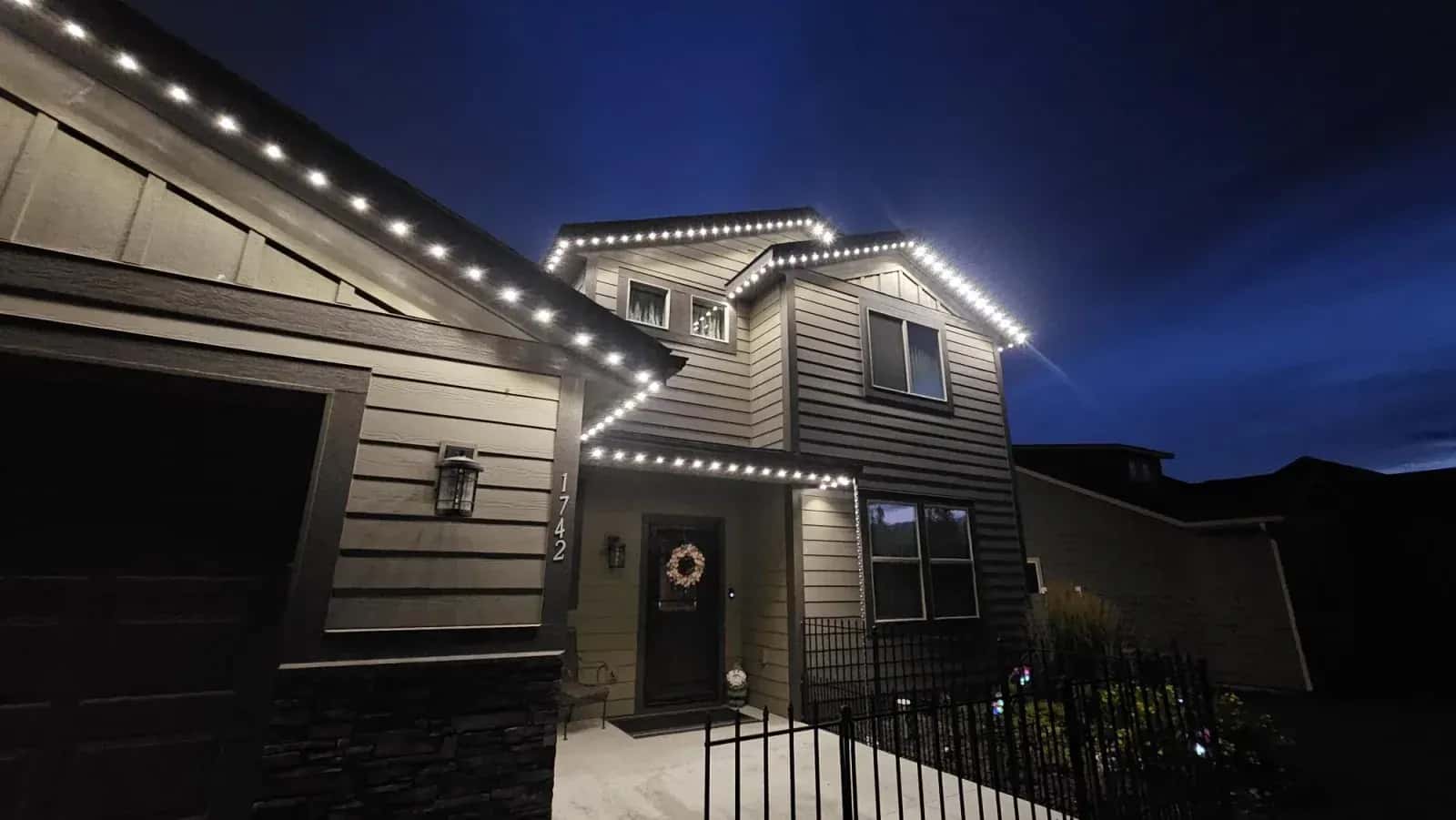
A professional system is an extruded aluminum channel, cut on site to your rooflines, holding individually addressable RGBW points spaced evenly along its length. It is screwed mechanically to the soffit or fascia, colour-matched to your trim in white, black, brown or a custom shade, wired with low-voltage cable back to a weatherproof controller, and fed from a GFCI-protected outlet. The hardware is sealed to IP67, uses CSA-listed components, is rated to operate at -40°C, and the LEDs themselves are rated for 50,000 hours. That list is not marketing; it is the difference in what the parts are built to survive.
Mounting: adhesive and clips versus screws in a channel
This is where most DIY installs start to come apart, sometimes literally. Adhesive backing is rated for clean, dry, room-temperature surfaces. The underside of a vinyl soffit in Strathroy in April is none of those things. Even when a strip sticks well in the fall, a winter of freeze-thaw cycles, wind-driven snow and the daily expansion and contraction of vinyl works at the bond until a section lets go. Plastic clips do better, but they hold the strip at intervals, so between clips the strip sags into a scallop that is visible in daylight and casts uneven light at night.
A rigid aluminum channel does not sag because it cannot. It is screwed into the fascia board or soffit framing at regular intervals, following the roofline in straight runs and mitred at peaks and corners. From the ground it reads as a thin trim line, which is why a professional track can stay up for years without anyone noticing it in July. The channel also acts as a heat sink for the LEDs, which is part of why they last.
Then there is the two-storey problem. On a bungalow with eight-foot eaves, a homeowner on a step ladder can mount a kit carefully and check the alignment as they go. On a two-storey home in a newer London subdivision, the eaves are twenty feet up over a sloped lawn, the peaks are higher still, and the soffit is deep enough that you are reaching in under it while balancing. Professional crews use the right ladders, standoffs and lifts, carry liability insurance and WSIB coverage, and do this every week. Time on a ladder is the cost of DIY that never shows up on the receipt.
Brightness and how it holds up along a run
Consumer strips are bright when you hold them in your hand. Mounted twenty feet up and viewed from the street, they often look dim, and the reason is usually not the LED but the power feeding it. A single plug-in adapter pushes current in at one end of the run. Low-voltage systems lose voltage along the length of the wire, so the far end of a long run receives less than the near end and the lights there are visibly dimmer and often warmer or redder in colour. On a strip that circles a whole house from a single power point, the last twenty feet can be noticeably weaker than the first.
Professional installers plan around this with power injection: additional low-voltage feeds tied in at intervals so every section receives the voltage it was designed for. It is invisible from the street, but it is the difference between an even line of light across the whole roofline and a display that fades toward the garage. Each point draws about 0.3 watts, so the total load stays small; the issue is distribution, not consumption.
Weatherproofing for an actual Ontario winter
Ratings on consumer kits vary, and the fine print often distinguishes between the strip itself and the connectors, controller and power adapter, which are frequently rated for splash only. The weak points are the plug-together joints between sections. Water gets in, freezes, expands, corrodes the contacts, and the section beyond that joint goes dark. In our area the trigger is usually the first proper ice storm, or lake-effect snow that packs into the soffit and melts on a sunny afternoon.
On a professional system every part that lives outside is sealed to IP67, which means dust-tight and protected against immersion, and the low-voltage connections between track sections and back to the controller are sealed and tucked into the soffit or behind the fascia rather than exposed at the eave. The controller and power supply are mounted in a weather-rated enclosure or inside the garage. The system is designed on the assumption that it will be buried in snow, coated in ice and baked in August sun for many years, because that is the job.
Wiring, power and the outlet question
Most DIY kits assume there is an outdoor outlet near where you want the lights to start, and that you are happy with a power adapter hanging off it and a cord running up the wall to the eave. On a professional install, the low-voltage cable is routed inside the soffit and down an inconspicuous path to a controller near an existing GFCI-protected receptacle. No permit is required for that connection, and there is no new line-voltage work, but the cable routing is what makes the install disappear. Both options run from a normal household outlet; the difference is where the wire goes and whether anyone can see it. A cord stapled up the siding is the tell of a DIY job from a hundred feet away.
The app, and who owns the lights in your phone
Consumer kits generally run on the manufacturer's cloud app, which is convenient until the company changes its app, drops the product line, or stops supporting your controller. Professional systems also use a Wi-Fi controller and an app with scenes, zones, dimming and schedules, but you have an installer on the other end of the phone who can walk you through re-pairing after a router change and who replaces the controller if it fails. Ask any installer what happens to the app in five years. A good one will have an answer.
Warranty, service calls and year three
A consumer kit typically comes with a one-year manufacturer warranty that covers the product, not the labour to get it down and put the replacement up. When a section fails in year three, you are back on the ladder, and the replacement may not match the colour or spacing of the original if the product has been revised.
A professional installation from Forever Lights carries a five-year parts warranty and a one-year workmanship warranty. If a connector fails or a point goes dark, you call (519) 914-3404, tell us where the dark section starts, and we send a crew with a lift. You do not climb anything, and we carry matching track and points so a repair looks like the original. That service model is a large part of what the price difference buys. One DIY replacement in January, on an icy driveway, with a borrowed extension ladder, is a cost too.
Resale and how the house reads in daylight
Real estate agents in London will tell you that exterior lighting lifts perceived value, but the effect depends on how it looks with the lights off. A colour-matched aluminum track that reads as trim is an upgrade a buyer inherits happily. A sagging strip with visible clips and a cord up the siding is something a buyer mentally deducts for, assuming they will have to remove it. If you plan to sell in the next few years, daytime appearance matters more than the night-time show.
When DIY genuinely makes sense
We would rather tell you the truth than sell you a system you do not need. DIY is a reasonable choice when most of the following are true:
- Your eaves are reachable from a step ladder on flat ground, such as a bungalow or the garage side of a split-level.
- You are renting, or expect to move within a couple of years.
- You mainly want lights for a few weeks in December and are content to treat the kit as semi-seasonal.
- You can split runs across multiple power supplies and will seal the joints yourself.
- You accept that you, not a warranty crew, will be doing any repairs at roofline height.
Professional installation makes more sense on a two-storey or taller home, steep pitches, deep soffits, a brick or stone front with no easy mounting surface, or when you want a year-round architectural feature nobody can see in daylight. It also makes sense when you never want to be on a ladder in a Southwestern Ontario January again, which for a lot of homeowners is the whole point.
The third option most people miss: professional hardware, self-installed
The comparison above sets a consumer strip kit against a professionally installed system, because that is the choice most people think they are making. There is a middle path. You can buy the same aluminum track, the same sealed RGBW pucks, the same controller and the same weatherproof connectors we mount on our own installs, and put them up yourself. That removes the hardware compromise entirely and leaves only the labour question.
That is what our DIY kits are. Each one is boxed by roofline length, from 50 feet up to 250 feet, and includes the track, the light strands, the power supplies, the WiFi controller and every connector, T-splitter and amplifier the run needs. The fittings are sealed twist connectors, so there is no cutting, stripping or soldering. The parts warranty is the same five years we give our installed customers, and phone support from our crew comes with it.
- You keep the labour cost, which on a typical home is several hundred dollars.
- You get architectural-grade hardware rather than a consumer strip, so the daylight look and the winter performance match a professional install.
- You take on the measuring, the ladder time, the mounting and the commissioning, plus the workmanship risk, since we can only warranty how a kit was built, not how it was hung.
Making the call
If you are on the fence, look at your own house from the street in the daytime and ask where the track would go and how you would get there. If the answer is a step ladder on the patio, a kit is a fair experiment. If the answer involves a thirty-foot ladder on a slope, or the words "I will figure it out," get a free site visit first. We will measure the rooflines, show you what the track would look like on your soffit, and give you a written quote, with 24-month financing at 10% APR available on approved credit. Our cost estimator gives a rough sense of scale before anyone comes out. Either way you will be comparing the two options with real numbers for your home, not the ones on the box.
Frequently asked questions
Can I install permanent LED lights myself?
Yes, consumer kits are designed for it, and on a single-storey home with reachable eaves a careful owner can do a reasonable job. The results tend to fall short on two-storey homes because of mounting, voltage drop along long runs and exposed connectors that fail in winter. Ladder safety at height is the bigger concern.
Why do DIY light strips look dim at the far end?
Low-voltage runs lose voltage along their length. A single plug-in adapter at one end cannot hold full brightness across a whole roofline, so the far end dims and shifts colour. Professional installs add power injection feeds at intervals so every section receives the voltage it needs.
Will a DIY kit survive an Ontario winter?
The strip itself often will. The plug-together connectors, adhesive and exposed power adapters are the usual failure points after an ice storm or repeated freeze-thaw cycles. Professional systems are sealed to IP67 throughout, rated to -40°C and mounted so the connections are protected inside the soffit.
What does a professional warranty actually cover?
Forever Lights installs come with a five-year parts warranty covering LED points, track, connectors, the power supply and the controller, plus a one-year workmanship warranty. Repairs are done by our crew at roofline height, so you never go up a ladder to fix them.
Do professionally installed lights add value to my home?
Exterior lighting is widely regarded as a curb-appeal upgrade, but the effect depends on the daytime look. A colour-matched aluminum track that reads as trim is an asset to a buyer; a sagging strip with visible clips and cords is usually something they plan to remove.
Can I buy the professional hardware and install it myself?
Yes. We sell the same track, lights, controller and connectors as complete DIY kits by roofline length, from 50 to 250 feet, shipped across Canada. They carry the same 5-year parts warranty as our installed systems and include phone support. The 1-year workmanship warranty applies only where our own crew did the install.
Want a number for your own home?
Get a fast ballpark with our cost estimator, or book a free, no-pressure site visit and we'll measure your exact roofline. Financing over 24 months at 10% APR is available on approved credit.
Related guides
Permanent vs. Seasonal Christmas Lights: An Honest Comparison for Ontario Homeowners
A fair, detailed look at permanent LED track lighting versus a seasonal hang-and-remove service versus DIY string lights, weighing cost, safety, convenience and looks.
Read guideCelebright vs. Gemstone vs. Trimlight vs. Govee: An Honest Comparison
A balanced, no-hype look at how the major permanent LED lighting systems actually compare on LED quality, daytime track visibility, app control, colour range, warranty and price.
Read guideHow Permanent LED Lighting Works: A Homeowner's Guide
A plain-language look at the track, the addressable RGBW LEDs, the controller and smartphone app, and exactly how permanent lighting disappears in daylight.
Read guide